- Choose Guangu Technology: Environmentally Friendly Polishing Machines Aren't Really Expensive
- A New Choice for Surface Treatment of Press-Fit Studs: Why Does Magnetic Polishing Achieve "Fast and High Quality"?
- Elastic R-shaped Pins and Magnetic Polishers: The Invisible Partner of Precision Manufacturing
- Innovative breakthrough of large metal polishing machine: magnetic polishing
- Magnetic polisher and plane polisher: Gemini of precision manufacturing
- Why magnetic polishers process metal surfaces so quickly
E-mail:zhihong@szguangu.com
Phone:18626103335
TEL:400-800-3945
Address:No. 333, Zixu Road, Xukou Town, Wuzhong District, Suzhou
A New Choice for Surface Treatment of Press-Fit Studs: Why Does Magnetic Polishing Achieve "Fast and High Quality"?
In the manufacturing fields of electronic equipment, automotive parts, and precision hardware, press-fit studs are key components for connecting and fixing core parts. Their surface quality directly affects the assembly accuracy, corrosion resistance, and appearance of the product. However, press-fit studs often face problems such as burr residue, oxide layer adhesion, and surface scratches during the production process. Traditional Polishing methods are either inefficient or have unstable results, becoming an "invisible bottleneck" restricting production line yield and delivery cycle. In recent years, magnetic polishing technology, with its "fast and high quality" characteristics, has gradually become the preferred solution for surface treatment of press-fit studs. This article will analyze its principles, advantages, and Application value in depth.
I. Pain Points in Surface Treatment of Press-Fit Studs: Why Are Traditional Methods "Inadequate"?
Press-fit studs are mostly made of stainless steel, Aluminum alloy, or carbon steel. After stamping and stretching, the surface often retains processing burrs, metal debris, oxide film, or oil stains. If these defects are not thoroughly removed, they may lead to the following problems:
? Assembly abnormalities: Burrs may scratch mating parts or obstruct riveting holes, causing loose connections;
? Reduced corrosion resistance: Oxide layers or residual contaminants can damage the surface passivation film, accelerating corrosion;
? Appearance defects: Scratches or color differences affect the product's aesthetics, making it difficult to pass inspection, especially in fields with high appearance requirements such as 3C and medical equipment.
Traditional polishing methods mainly include mechanical polishing (belt sander, vibratory plate), chemical polishing (acid etching), and manual polishing:
? Mechanical polishing: Relies on friction from hard abrasives, easily leading to over-polishing or under-polishing due to uneven pressure, resulting in poor consistency in batch processing;
? Chemical polishing: Requires strong acid/alkali solutions, posing high environmental risks, and has insufficient coverage for complex structures (such as stud threads);
? Manual polishing: Relies entirely on worker experience, resulting in low efficiency (5-10 minutes per piece) and high labor costs.
The core of these pain points lies in the difficulty of balancing efficiency, consistency, and cost using traditional methods. Magnetic abrasive polishing offers a solution to this problem.
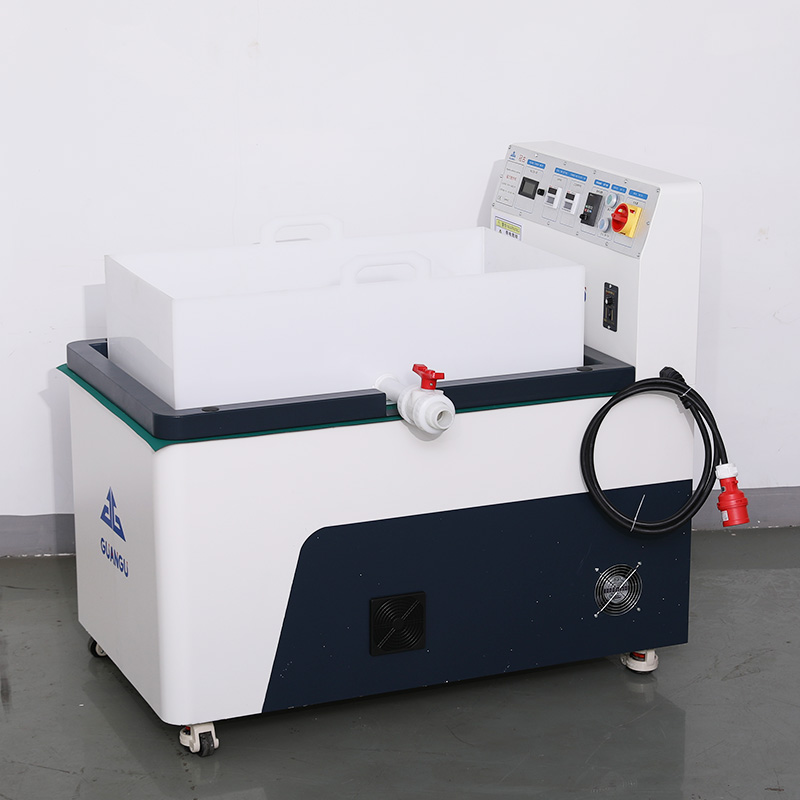
II. The Core Principle of Magnetic Polishing: Achieving Precise Cleaning with Microscopic Magnetic Fields
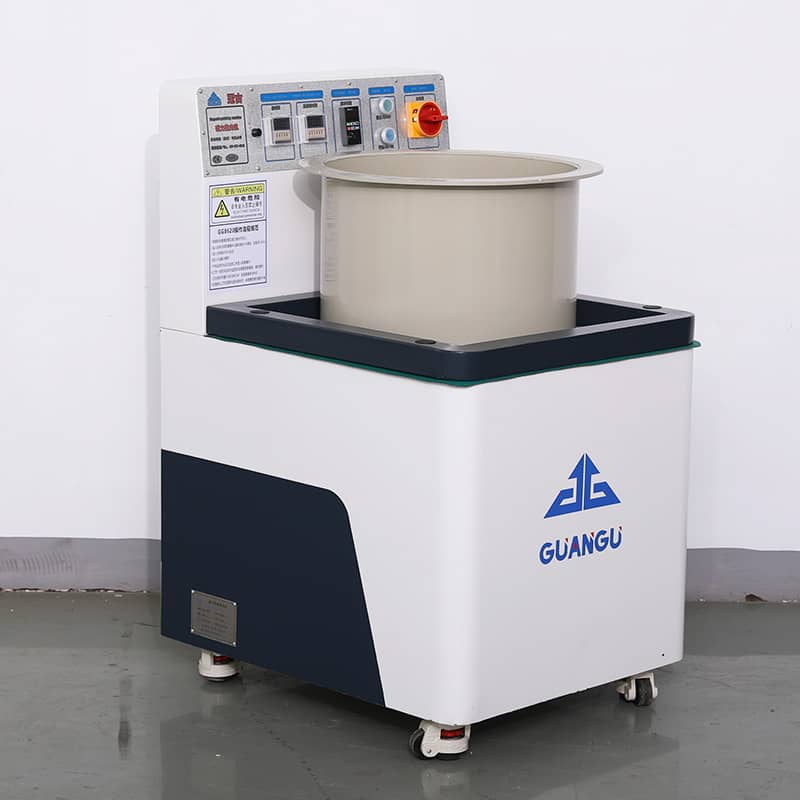
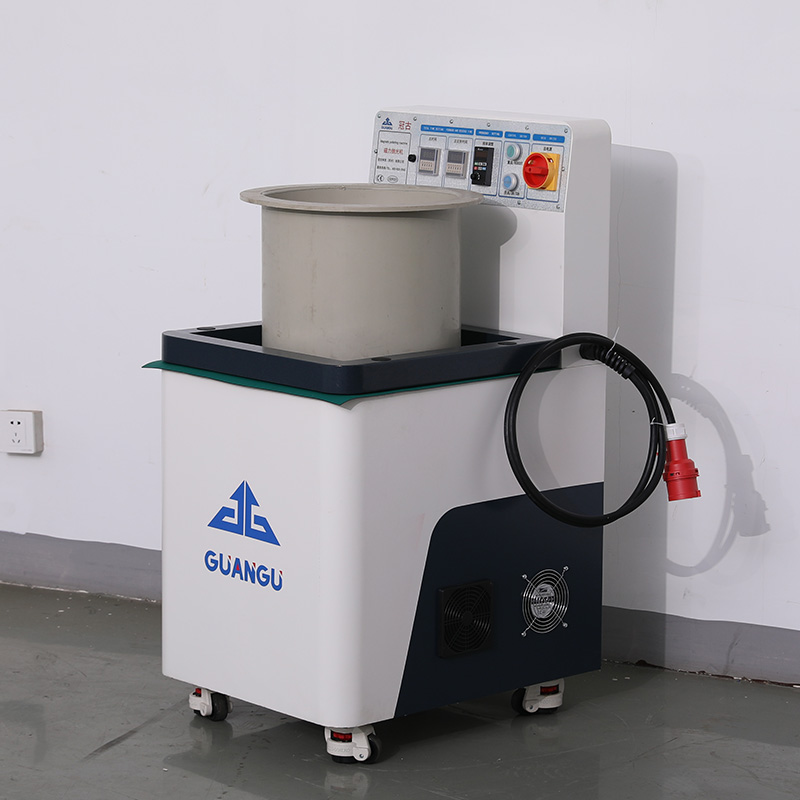
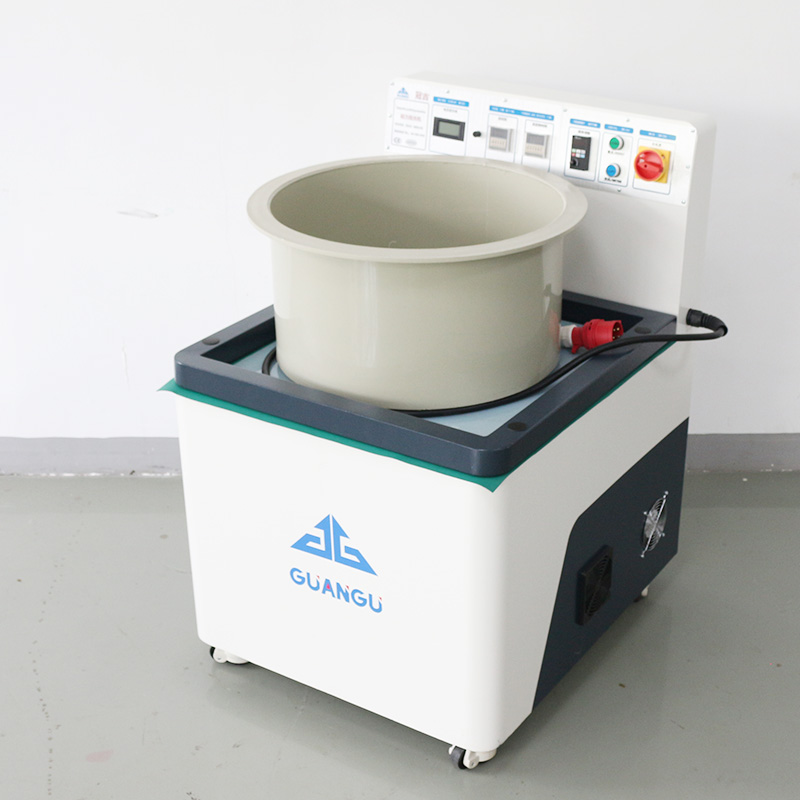
Magnetic abrasive polishing (MAP) is a non-traditional polishing technology based on the synergistic effect of electromagnetic fields and abrasive particles. Its Working Principle can be simplified to the following steps:
1. Magnetic field construction: A controllable alternating magnetic field is generated inside the equipment through an array of electromagnets or permanent magnets;
2. Abrasive activation: A magnetic composite grinding head (or suspension) containing abrasives (such as alumina or silicon carbide) is placed in the magnetic field, where the abrasives are magnetized to form "magnetic brushes";
3. Micro-cutting: Driven by the magnetic field, the "magnetic brushes" vibrate at high frequency and small amplitude (typically 50-200Hz), uniformly cutting the workpiece surface to remove burrs and oxide layers;
4. Adaptive fitting: The magnetic field can automatically adjust the abrasive distribution according to the shape of the workpiece, achieving thorough processing even for complex structures such as helical grooves and blind holes in studs.
In short, magnetic polishing is like equipping the abrasive with "intelligent navigation," precisely removing defects while avoiding excessive damage to the substrate, making it particularly suitable for small-sized, high-precision metal components such as press-fit studs.
III. Why does magnetic polishing make press-fit stud processing both "fast and good"?
Compared to traditional methods, magnetic polishing demonstrates significant advantages in efficiency, effectiveness, and cost:
1. Increased Efficiency: Batch processing time reduced by over 80%
Traditional vibratory polishing requires 30-60 minutes per batch (depending on the number of studs), while magnetic polishing machines can accommodate 5-10 kg of workpieces simultaneously, with a single processing time of only 5-15 minutes. For example, in an electronics factory processing 500 kg of press-fit studs daily, traditional methods require 10 people working in shifts, while magnetic polishing requires only 2 people, increasing production capacity by 4 times.
2. Stable Results: Surface roughness Ra≤0.2μm, strong consistency
The magnetic brush in magnetic polishing adapts to the curved surface of the workpiece, ensuring uniform processing of the same parts of each stud (such as the head, shank, and threads). Actual test data shows that after magnetic polishing, the surface roughness of the press-fit studs can be reduced from the initial Ra1.6-3.2μm to Ra0.1-0.4μm, with a burr removal rate >99% and a batch processing defect rate <0.5% (compared to approximately 3-5% with traditional methods).
3. Cost Optimization: Low wear and no consumables, resulting in a 30% reduction in overall cost.
? Long abrasive life: Magnetic abrasives can be reused more than 50 times after sieving, with a wear rate only 1/10 that of chemical polishing reagents.
? Water and electricity saving: No need for large amounts of chemical solutions or cooling water; single-machine power consumption is 40% lower than that of vibratory feeders.
? Labor saving: High degree of automation, reducing reliance on skilled workers and lowering training and management costs.
4. Strong adaptability: Compatible with press-fit studs of multiple materials and structures.
Whether it's stainless steel (304/316), aluminum alloy, or carbon steel press-fit studs, magnetic polishing allows adjustment of the magnetic field strength and abrasive particle size to match the requirements. For threaded studs, the high-frequency micro-vibration of the magnetic brush does not damage the thread profile, and the surface treatment still meets the assembly accuracy requirements.
IV. Practical Application Case: From "Problem Workshop" to "Benchmark Production Line"
A certain automotive parts company's stud production line previously experienced frequent assembly line stoppages due to burr issues, with a defect rate as high as 8%. After introducing a magnetic polishing line:
? Surface treatment time was reduced from 45 minutes/batch to 8 minutes;
? Burr removal rate increased to 99.5%, and assembly stoppages decreased by 90%;
? Annual savings of approximately 800,000 yuan in labor and consumable costs.
The company's technical manager reported: "Magnetic polishing not only solved the surface quality pain point but also reduced our delivery cycle from 7 days to 3 days, significantly improving customer satisfaction."
Conclusion: Magnetic Polishing—The "Future" of Stud Surface Treatment
In the context of the manufacturing industry's transformation towards "high precision, high efficiency, and green manufacturing," magnetic polishing, with its technological advantages, has become the mainstream choice for stud surface treatment. It not only solves the efficiency and consistency problems of traditional methods, but also meets diverse production needs through intelligent adaptation. For manufacturing companies that pursue quality and cost, embracing magnetic polishing may be the key to unlocking a new era of "fast and good" production.
- Previous:Elastic R-shaped Pins and Magnetic Polishers: The Invisible Partner of Precision Manufacturing
- Next:No time
-
2022-10-18Deburring of stainless steel stampings